June 2026
The Spin Doctor, Michaels Trei tries fancy silver cables from Argento Audio.
A lot of us are vulnerable to marketing and hype, especially when we are young and impressionable. As a young kid, I was convinced that Sea Monkeys for a dollar from the back of a comic book would bring me a bowlful of happiness, until my Uncle Jim convinced me that not all was what it seemed.
Uncle Jim was my dad’s lifelong best friend, the closest thing to an Ernest Hemingway type I ever knew.1 Jim flew helicopters for the US Navy in Antarctica and had double the flying hours of any other pilot on that continent. He was the pilot during two fatal accidents caused by engine failures in the frigid weather, and he managed to survive both. After the Navy, Jim’s idea of a relaxed retirement was to go, with my dad, to the San Fermín festival in Pamplona, Spain, each year for the famous running of the bulls. In 2002, he was gored by a bull but survived that too and returned to his home in Albuquerque to take up a more sedate hobby, hot air ballooning. In 2008, I received an invitation to Jim’s 75th birthday party: The invitation was a ski trail map for Taos, New Mexico, with an arrow pointing to a cabin several hundred feet above the end of the ski lift. The words “party here” were written on the map. Apparently, only two guests made it up to the cabin; the three of them skied to the base chalet to join the other guests. Four years later, Jim died when his big heart gave out while he was hiking on New Mexico’s tallest mountain, Wheeler Peak. I expect that’s how he would have scripted it.
Uncle Jim was a smart guy, and I trusted him implicitly. So as a 10-year-old I took his advice and didn’t waste a buck on Sea Monkeys. If only he had been there a few years later when I was trying to put together my first real hi-fi system.
When I arrived for my freshman year at Syracuse University in 1980, there were two requirements for dorm life: a good supply of weed and a kick-ass stereo. I was a budding audiophile and had never partaken in the former, so getting a stereo together was priority number one. My first roommate was a crew jock called Stu, and he brought some of the parts we needed, but not all. His turntable was a classic Dual 1019 handed down from his parents, and he had a surprisingly good-sounding pair of homemade speakers that had been built by his brother.
What we still needed were the bits that go between the turntable and the speakers—that is, an amplifier with a phono preamp. I had brought my boombox, an Aiwa TPR-920, which I still had from my last year at boarding school in England. It had a built-in phono preamp and loudspeaker output jacks, so I figured we should be able to cobble it all together to make a working system, albeit an unconventional one.
What I learned from this experience is the importance of perspective and balance in system building.
To connect Stu’s homemade speakers to the Aiwa, we would need some speaker cables. Being an audiophile, I knew that cables would affect the sound quality and that good cables were important. Back in England, the budget cable of choice was something called QED 79 strand, but that didn’t seem to be available in the States, so I settled on something I’d seen advertised in the pages of Audio magazine, from a new company called Monster Cable.
In Syracuse, the local stockist was a store called Gordon Electronics on Erie Boulevard East. On a map it looked pretty close to my dorm, so I figured I would walk there. Having grown up mostly in England, I didn’t understand that a single street in a US city can stretch for miles. Gordon’s address was actually a good three miles from my dorm. Still, I persevered, walking along a busy road that clearly was not designed for pedestrian traffic, until I reached the store and procured my Monster Cables. Back at the dorm, I somehow managed to find a way to connect the big fat cables to the Aiwa’s 3.5mm mini jack speaker outputs and got it all to work, convinced that the big Monster Cables would be an important part of the equation. Stu, however, soon grew tired of this assembled mess, and after his next visit home, he returned with another hand-me-down from his parents, a Sansui AU-217 integrated amp. This clearly blew the Aiwa’s puny 3.7Wpc amp out of the water, despite my only being able to connect it using lamp cord for some forgotten reason.
What I learned from this experience is the importance of perspective and balance in system building. No single component change is going to make the imaging holographic, the bass thunderous, and the midrange rich and creamy. What you really need is a thousand of those little changes, so they all add up to achieve those goals. Better cables definitely can make a difference in your sound, but it’s critical to get the fundamentals right first. It makes little sense to spend an ungodly sum on cables if budget pressure forces you to compromise on the basic components.
After that early Monster Cable boom box experience, I became a bit ambivalent about the make-or-break nature of the cables in a system, but then one day my friend Jeff called and asked me to come over and help him decide between three AC power cables. Really? What’s more, he wanted to compare them powering his phono preamp. To be honest, I was worried whether I would be able to hear any repeatable differences in a quick A/B/C test. Normally, I like to embed anything I’m auditioning into my system for a few days or weeks, and only then switch back to my regular setup so I can focus on the differences. Surprisingly, not only was it pretty easy to hear clear and repeatable differences between the power cables, I even disagreed with Jeff at first about which one was the best but eventually got him to agree with me. Score one for my powers of persuasion.
For most of the last 35 years, I have mostly used cables from Cardas Audio in my system. I find they match well with the equipment I use and offer excellent value at various price levels. I got to know George Cardas and his family back in the late 1980s while working at Sound by Singer, and we became one of Cardas’s first dealers. More recently, I upgraded many of my 30-year-old Cardas cables to more current versions, resulting in a clear uptick in performance. These days Cardas Audio remains a family business, with George’s youngest daughter Angela at the helm.
It takes bravery to review audio cables, especially if they cost more than some Amazon Basics interconnects or a roll of 16-gauge lamp cord purchased from the local Home Depot. Any suggestion that something more ambitious might actually sound better will be met with slings and arrows from the “you couldn’t tell them apart from coat hangers” crowd, many of whom seem convinced that loop resistance is the only characteristic that matters.
If you want a simple test that anyone can try to show that there’s more to cable performance than simple loop resistance, try my scratch test. Just turn up the volume of your phono input with no record playing, then tap the tonearm cable with a pen, or scratch it with your fingernail. In most setups, you will clearly hear the noise through your speakers or headphones. That experiment shows the importance of designing (and using) a cable that minimizes microphonics. For a deeper understanding of why cables really do sound different, I usually point people toward the papers written by Dr. Malcolm Hawksford. Professor Hawksford is a man whose deep knowledge of cable theory goes magnitudes beyond my own simplistic high school physics understanding. For a primer, see the article in Stereophile.2 Part of the problem is that the cost of top-quality cables seems to increase at a rate much faster than inflation. I remember in the mid-1980s when Monster Cable introduced their Interlink Reference A interconnects. Everyone was aghast at the stratospheric price of $80 for a 1m pair. Fast-forward a decade to when I reviewed the Hovland tonearm cable for Art Dudley’s Listener magazine; even I was balking at the $800 price tag.
Three decades later comes the Argento Audio Flow Ultima phono cable. Again we must add a zero to the price tag.
The Argento Audio Flow Ultima
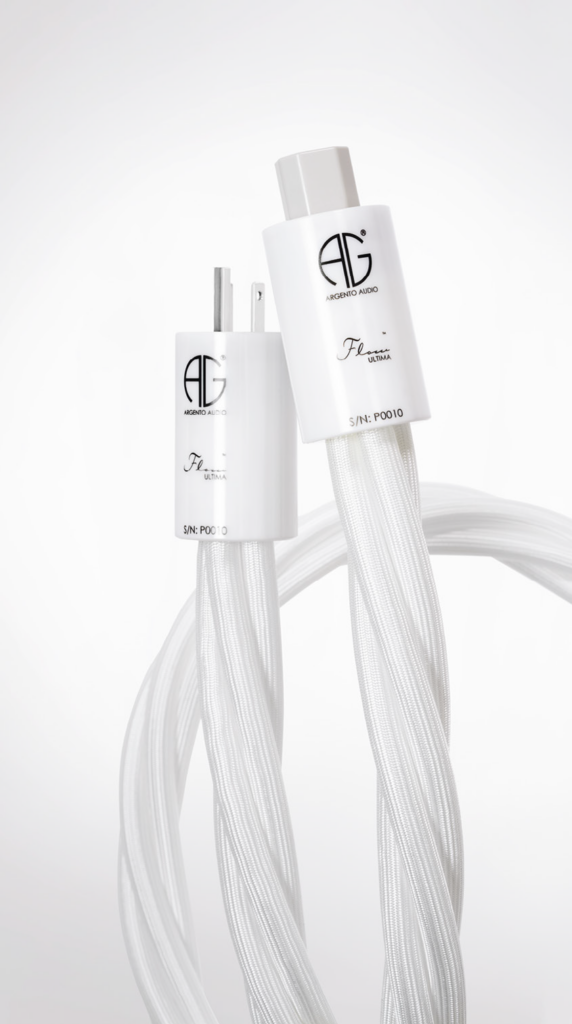
Founded in Denmark in 1991, Argento built its reputation on bespoke silver-wire cables that use wire configurations and connectors of their own design. I received two cables from Argento’s most affordable line of silver wire, Flow Ultima. The cables themselves use ultrapure six-nines long-crystal (as in, extruded single-crystal) silver, with a carbon fiber absorptive shield. To minimize microphonics, they inject something uncreatively called VDM (Vibration Damping Material) at high pressure into the cable itself. The connectors are made from a hard polymer called PEEK, preferred for its mechanical and electrical properties. The contacts are also pure silver, connected to the wire using a pressure fit: no solder.
I received a 2m pair of the RCA to RCA Flow Ultima phono cables to go from my Brinkmann La Grange turntable and 10.5 tonearm to the CH Precision P1 phono preamp, and a 2m Flow Ultima power cable to use with the P1. Argento representative Ralph Sorrentino warned me that these cables take a long time to break in, so I hooked them up in my system when I wasn’t auditioning anything and used them for casual listening two months before sitting down to do focused listening.
Tonally, the Flow Ultimas are essentially neutral, with not a hint of brightness and clear, powerful bass.
Despite being Argento’s lowest-cost silver cables, the Flow Ultima Phono RCA to RCA costs an eye-popping $8850 for a 1m pair, and the 2m power cable is $6850. That puts them in the luxury-goods category for sure. They were packaged to suit, in zippered, fragrant, ultrasoft leather cases any Hermès owner would find familiar. In contrast to many cables I have used, the Flow Ultimas are flexible and won’t force you to move your rack out so there’s enough clearance to run them.

There’s a cliché that silver cables tend to sound bright, but I learned long ago, when I was distributing Audio Note/Kondo, that with their silver cables at least, it isn’t necessarily true. Like those AN silver cables, the broken-in Flow Ultimas have a relaxed, nonmechanical quality that delivers natural and organic sound. What was especially impressive is how they reveal astonishing levels of detail while still maintaining that relaxed quality. Loud and noisy recordings, like the title track from Frankie Goes to Hollywood’s Welcome to the Pleasuredome (Island Records ZTT 7 90232-1-H), took on an open and clear quality I wasn’t used to, allowing me to enjoy the music more with less teeth-gritting at the compressed sound. The usual tinge of glare was now replaced by detail and resolution.
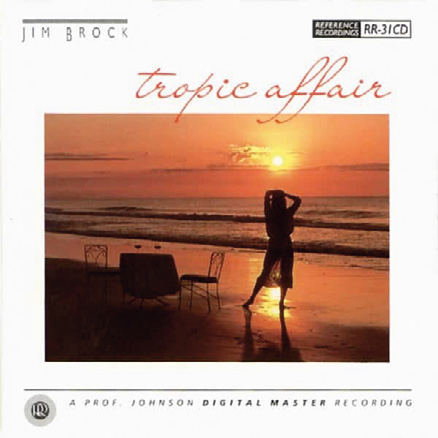
To dig deeper into the Flow Ultima’s resolution capabilities, I put on “Ladies of the Calabash” from Jim Brock’s album Tropic Affair (Reference Recordings RR-31). This smooth-jazz groove has plenty of Latin percussion, played by Brock himself, and captured perfectly by Reference Recordings engineer Keith Johnson. With the Flow Ultimas hooked up, I was able to get a better sense of space and the dimensionality and timbre of each instrument. Tonally, the Flow Ultimas are essentially neutral, with not a hint of brightness and clear, powerful bass. As my dad liked to say when presented with something expensive, “I’ve bought cars for less.” Indeed, many of the 25+ vintage Mercedes cars I’ve bought over the last 30 years cost less than a pair of Flow Ultimas. But you can say that about pretty much anything, and once I stopped complaining, I realized that the Flow Ultimas were extracting more from my system than I have ever heard.
If you can swing them, go for it, though I don’t advise connecting them to an Aiwa boom box.
The Collaro Audio Triscription record weight
In the nearly three years since I last wrote about record weights and clamps in Spin Doctor #4,3 I have noticed several new devices that take a less heavy-handed approach to record stabilization. The goal with these devices is to tamp down microvibrations rather than slamming them (and the record) flat with brute force.
A few weeks back, I got a distressed-sounding call from a regular customer named John, for whom I had recently set up a new Technics SL-1200G turntable with a Hana Umami Blue cartridge. This is an excellent combination, and everything was sounding great when I finished dialing it in. When he called, he told me that it was suddenly sounding bright and unfocused, so I headed over to check out what could possibly be wrong.
It turned out that after I left, he had acquired a heavy record weight and was using it to hold his records down. I prefer to use the SL-1200 with no weight. The thick rubber mat that’s standard with Technics turntables is excellent; even makers of other, more exotic turntables like the Dr. Feickert Volare and the Primary Control Kinea have chosen the Technics mat for its fine performance. One quirk is that it has a deeper-than-usual recessed label area to account for the slightly thicker vinyl in that part of a record.
What was happening with John’s 1200G is, the heavy weight was pushing the label area down into the recess, which in turn was causing the playing area to get pushed up, with a visible gap between it and the rubber mat. With no mat to support the record and damp vibrations, it was resonating in the free air. When the heavy weight was removed, the brightness disappeared, and all was clear and detailed again. What John really needs is a more carefully considered weight that works using damping technology rather than sheer brute force.
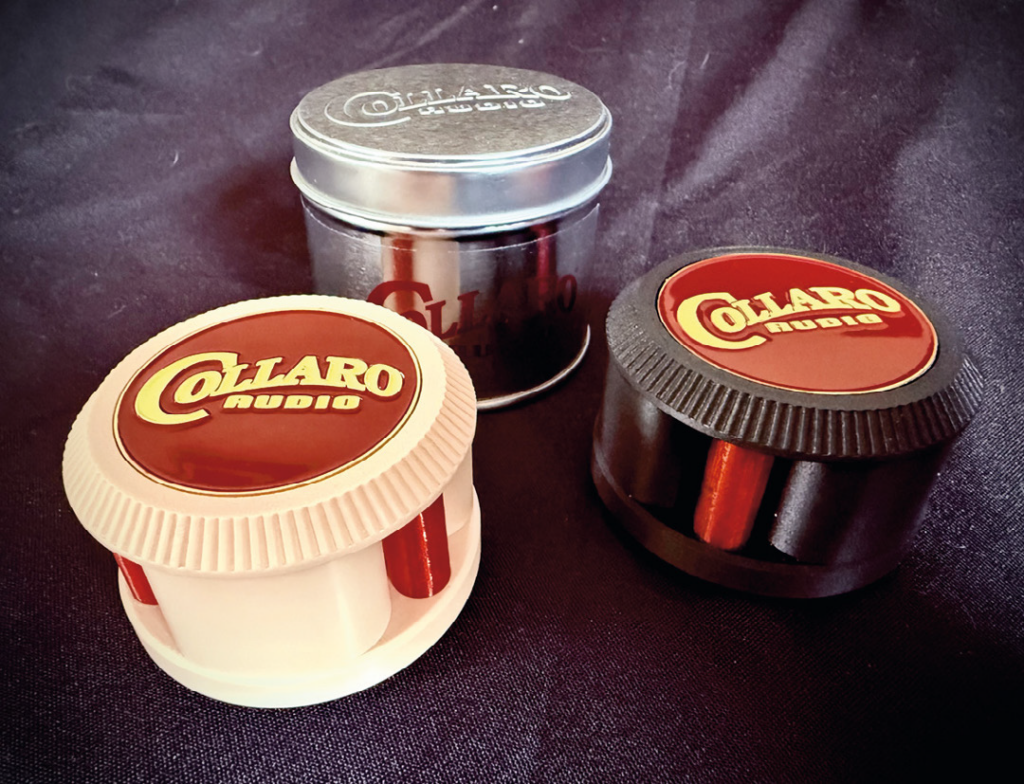
In that Spin Doctor #4 piece mentioned above, I checked out Collaro’s Precision Cloth Turntable Mat, which was designed to appeal to fickle Linn LP12 enthusiasts. Since then, Collaro has introduced a thicker version of their cloth mat, called the Tempest, that’s optimized for rigid turntables like idlers and direct drives. They also introduced two versions of a record weight called the Triscription. While Collaro still uses the word “weight” to describe the Triscription, at 325gm (11.46oz) it has less than half the heft of the Acoustic Signature Load-S (715gm) or the Ultra Carbon TC-40 (985gm), which I reviewed previously. For smaller, lighter turntables, like the Rega Planars, and suspended turntables like Linn LP12s, Collaro also offers a 145gm Triscription Lite. These two weights join other vibration-damping “weights” already marketed, including the Tangerine Audio Evenstar, StackAudio Serene, Black Ravioli Record Ground, and Origin Live Gravity Two, as the preferred approach for those types of turntable.
I received the standard Triscription weight, which contacts the record label through three stainless steel balls near the perimeter of its flat underside. The balls are compliantly mounted, supported by three red sleeves filled with unspecified damping material. These transfer the vibrations from the record via the three balls and dump it into a hidden weight supported by the three red towers. Collaro says the technology is derived from a system developed in the 1990s to isolate spinning computer hard drives in a hovering helicopter during measurement flights. While I hope your turntable doesn’t vibrate as much as a hovering helicopter, we have also learned that even the tiniest unwanted vibrations can dramatically affect turntable performance.
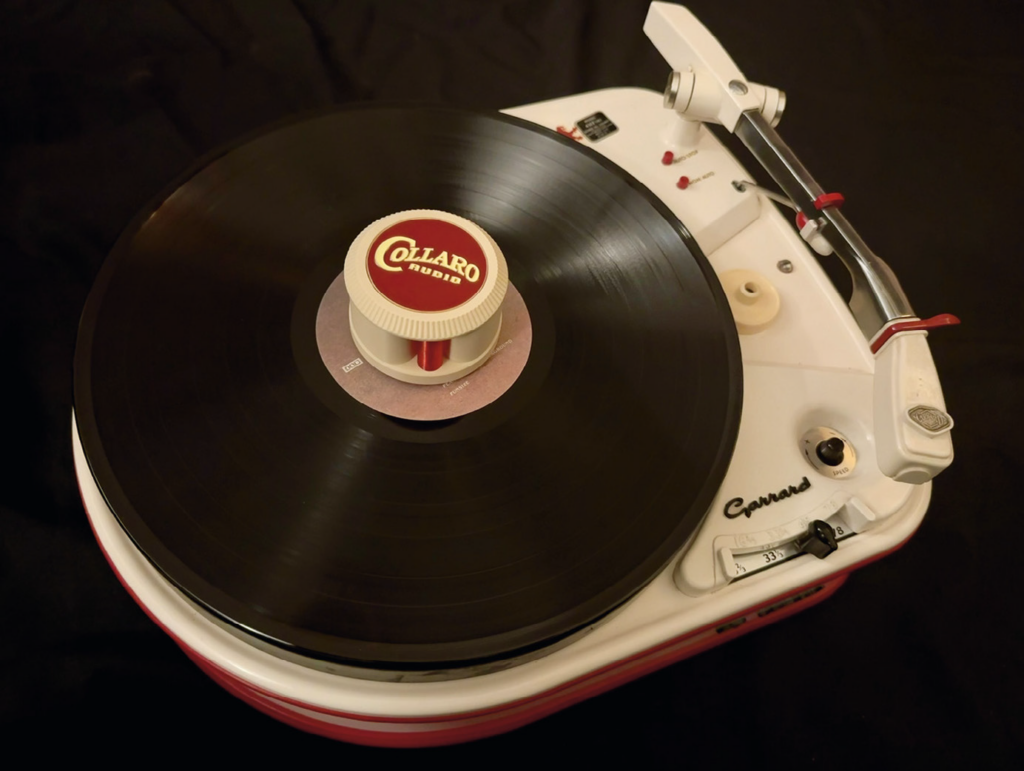
I didn’t have an idler-drive turntable set up and ready to go, so I used the Triscription with my trusty Brinkmann La Grange, a heavy German belt-drive turntable with a glass-topped 35lb platter. Normally this turntable uses a record-lifting washer and its own reflex-style clamp, so I removed the washer to allow the record to lie flat without the clamp. Collaro recommends using the Triscription weight in combination with their precision cloth mat, so I tried it both ways, with the record sitting on the Collaro mat, and directly on the glass platter.
Low-level details become easier to hear, so things like reverb tails and the leading edge of piano and bass notes become more sharply defined and clearer.
The mat-vs-no mat question was a mixed bag. With truly flat records, I preferred the results with the record placed directly on the glass platter. While relatively light, the Triscription had enough heft to ensure that the record was making good contact with the hard glass surface. When I tried a record that was less than mirror smooth, my preference changed, and I preferred the results with the Collaro mat and Triscription weight used together. For warped records, I returned to the Brinkmann’s lift washer and reflex clamp to really flatten out the dips and bumps. Adding or removing the Collaro weight was very easy and could even be done as the record was playing, making quick comparisons simple.
The effect of the Triscription weight is subtle but clear. It’s one of those things where once you hear what it’s doing, it becomes hard to ignore. The effect is similar to what you hear from dialing in your cartridge’s alignment. Low-level details become easier to hear, so things like reverb tails and the leading edge of piano and bass notes become more sharply defined and clearer.
The Triscription record weight is available directly from Collaro in the UK for GBP 149, which at the time of writing is almost exactly $200. That’s cheap for such a simple and easy-to-use tweak that really works.
Notes
1 You can read about Uncle Jim at wikipedia.org/wiki/James_F._Brandau.
2 See stereophile.com/content/essex-echo-1995-electrical-signal-propagation-cable-theory.
3 See stereophile.com/content/spin-doctor-4-platter-mats-clamps-weights-timerette.
Contacts
| Company | Details |
| Argento Audio | Emborgvej 23, 8680 Ry, Denmark; Tel: +45 30 66 22 84; Web: argento.dk |
| US distributor: Musical Artisans | 4826 Main St., Skokie, IL 60777; Tel: (847) 983 0217; Email: reyes@musicalartisans.com; Web: musicalartisans.com |
| Collaro Audio | Tel: +44 (0) 345 388 2005; Email: quality@collaroaudio.co.uk; Web: collaroaudio.co.uk |