Argento Audio — Devoted to Silver
Text by Chitake Inoue · Photography by Norio Tashiro · Audio Accessory, Spring 2026
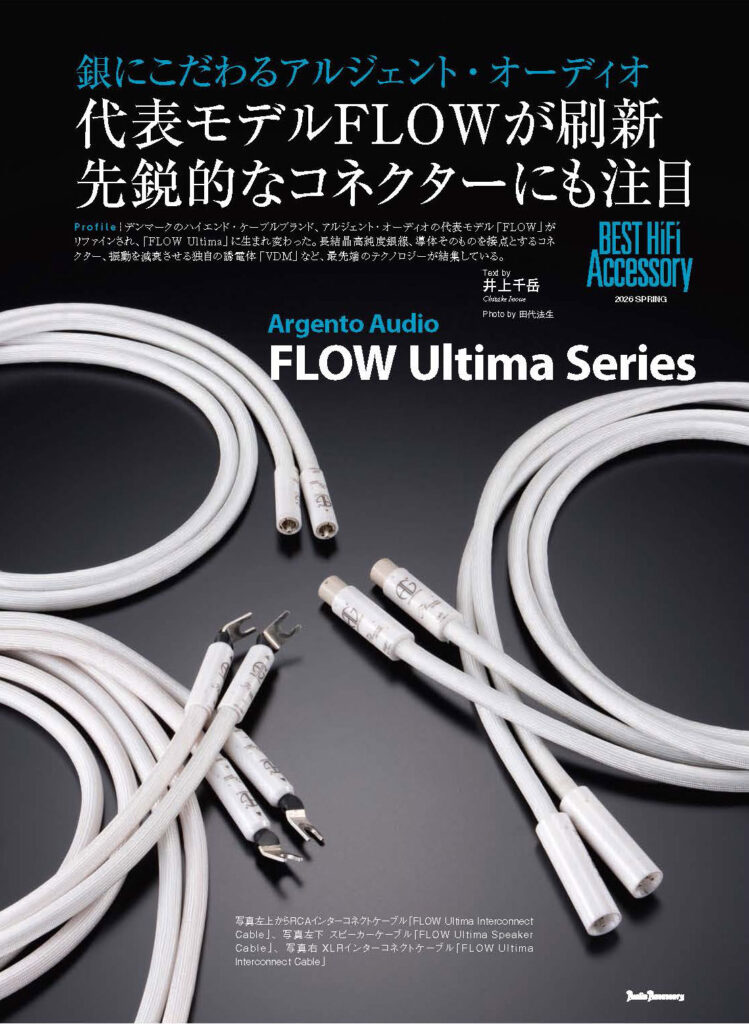
PROFILE The flagship FLOW model from the Danish high-end cable specialist Argento Audio has been refined and reborn as FLOW Ultima. The series brings together the brand’s most advanced technologies — long-crystal high-purity silver conductors, a new connector in which the conductor itself serves as the contact point, and the proprietary VDM dielectric developed to damp mechanical vibration.
A Groundbreaking Connector — Where the Conductor Itself Becomes the Contact Point
Argento Audio is a Danish cable brand founded in 1991. Pursuing the ultimate cable without compromise, the company has refined every aspect of its products — conductor material, insulation, mechanical structure, and more. The FLOW Ultima Series announced this time is the renewed version of the FLOW Series introduced 18 years ago. The brand’s foundational concept is a high-purity silver conductor of 99.997%. The structure consists of extremely fine stranded wires whose lengths are matched with strict precision, with their surface oxide layer polished away and the assembly treated with two rounds of cryogenic processing. For insulation, Argento has developed its own special material called VDM, which — unlike conventional polymers — offers both electrical insulation and mechanical damping properties. Inside the cable, the interior is sealed under high pressure and vacuum. The connectors employ a high-pressure crimped termination using the same pure silver as the conductor, together with a composite insulation made of a special fibre-woven material and a hollow pin design. The housing structure that raises the contact pressure is patented technology.
New Long-Crystal Silver Conductor and a Reimagined Connector
Building on these foundations, the FLOW Ultima Series newly adopts long-crystal pure silver conductors, with the previous quasi-elliptical ribbon geometry replaced by a new shape. More importantly, the conductor itself now serves directly as the contact point — a new connector structure has been developed for this purpose, and a patent has already been filed. This connector is one of the most significant elements of the renewal. For shielding, all models now incorporate a newly developed carbon-fibre absorption-type shield. Rather than merely blocking external electromagnetic energy, this technology reflects, absorbs and attenuates it, and is said to be particularly effective against high-frequency noise and ground-borne interference. All iron content has been eliminated from every part; high-strength zirconia ceramic screws and titanium screws are used throughout. Speaker cables and power cables are constructed with an independent structure for each polarity.
A Pure Sound With Every Obstruction Removed
For the listening evaluation, the cables were installed from source through to loudspeakers simultaneously, since the sound quality across the line is unified. The overall character is calm and entirely free of stress. Balance and response have no quirks or bias of any kind — one can plainly hear the signal being transmitted flatly and accurately. Layered on top of this is an extraordinary wealth of detail, extension and energy. It feels as though the source signal is being converted directly into sound in something close to an ideal state.
Neutral, with no exaggeration and no alteration, the reproduction shows no trace of dirt or distortion in its precise, finely drawn sound. Freshness is astonishingly high; fine details flow straight to the ear, with nothing standing in their way. The richness of Baroque writing is delivered as if every last corner had been swept clean. The delicate, finely shaded reproduction continues — fresh, clear, with even energy across every instrument. Period violin and cello have a moist richness, with a fine sparkling resonance wrapped around the body of the tone. Harpsichord and lute carry the same kind of resonance, lending the music an utterly real quality.
The piano, too, is rendered with complete naturalness. The touch has a rounded warmth; the bottom of the bass register extends smoothly while remaining transparent and clear; and even in the upper registers there is a thick core to the sound, with abundant body and substance. The transparency comes from the absence of any muddiness — no matter how dense the chord, nothing collapses. There is no interposed barrier between listener and music: the sound seems to arrive directly, with a sense of real presence.
The orchestra, too, has tonal beauty — as if the real instruments were standing right in front of you, vivid and finely detailed, their true timbres made to shine. Speed of attack, separation between notes, instantaneous energy — every desirable quality is accumulated here, producing a vivid, true-to-life reproduction beyond which there is nothing more to ask. A pure sound, with every obstruction removed. Now there is nothing left standing between you and the music. This feels like a glimpse of the ultimate destination towards which audio reproduction strives.
Specifications
- Conductor: Long-crystal high-purity silver
- Connector housing: Zirconia ceramic
- Screws: High-strength ceramic; titanium for high-load sections
- Japanese distributor: Stella Inc.
Listening Sources (CDs)
- Albéniz — Iberia, from “Spanish Piano Masterpieces” (Natsuko Hosokawa, piano)
- Vivaldi — The Four Seasons; La Tempesta di Mare and other concertos (Federico Guglielmo, violin; Nuova Accademia degli Italiani)
- Saint-Saëns — Symphonic Poems (François-Xavier Roth, conductor; Les Siècles)
Translated from the original Japanese article in Audio Accessory, Spring 2026, where the FLOW Ultima Series received the publication’s “Best HiFi Accessory” award. Original text by Chitake Inoue; photography by Norio Tashiro. Pricing and distributor details refer to the Japanese market.